The Moai statues of Rapa Nui (Easter Island) represent a singular achievement in ancient monumental sculpture and a profound cultural narrative. For content creators, historical researchers, and cultural heritage marketers, a detailed understanding of these monolithic figures moves beyond mere curiosity, offering rich context for narratives, visual assets, and thematic explorations. Grasping their meaning, distinctive stylistic elements, and historical trajectory provides a foundation for accurate representation and impactful communication, whether for educational platforms, documentary content, or culturally informed marketing campaigns.
Unpacking the Moai's Profound Meaning
The primary purpose of the Moai was to embody the deified ancestors (aringa ora) of the Rapa Nui people, serving as a spiritual conduit between the living and the dead. Each statue was a representation of a specific lineage's former chief or important person, designed to watch over the community and provide protection and prosperity. Their placement, typically on ceremonial platforms called ahu, with their backs to the sea and facing inland, reinforced their role as guardians of the village.
Spiritual and Ancestral Representation
The Moai were not idols to be worshipped, but rather vessels for the spirit of the ancestors. The act of carving and erecting a Moai was a highly spiritual endeavor, believed to imbue the statue with mana—a sacred, supernatural force. This mana was thought to radiate from the statue, blessing the land, ensuring fertility, and safeguarding the community's well-being. The eyes of the Moai, often inlaid with white coral and obsidian or red scoria, were particularly significant, believed to be the windows through which the ancestors observed and protected their descendants.
Societal Power and Status
Beyond their spiritual role, Moai also served as prominent markers of tribal power, status, and competitive display. The sheer scale and number of Moai constructed across the island reflect the advanced societal organization and resource management required for their creation. Families and clans invested immense resources—labor, time, and materials—into carving and erecting these statues, demonstrating their wealth, influence, and connection to powerful ancestral spirits. The larger and more numerous the Moai, the greater the prestige of the lineage.
Distinctive Stylistic Elements of Moai
The Moai possess a remarkably consistent, yet subtly varied, artistic style that makes them instantly recognizable. Carved primarily from volcanic tuff found at Rano Raraku quarry, their design emphasizes certain features while abstracting others, creating a powerful, stoic presence.
Key Anatomical Features
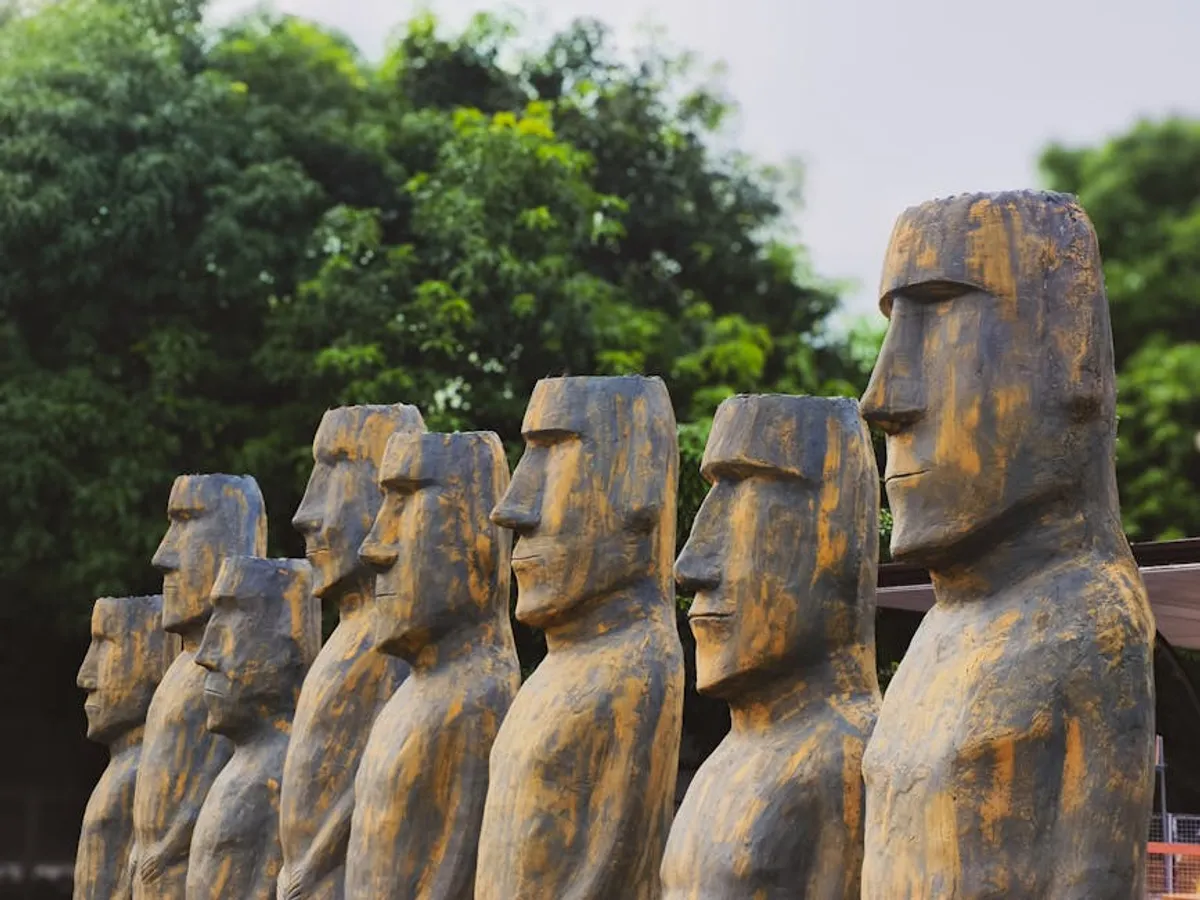
The typical Moai features an elongated head, often comprising up to one-third of the statue's total height. Prominent characteristics include:
- Broad Foreheads: Suggesting wisdom and intellect.
- Deep-Set Eyes: Originally inlaid with coral and stone, giving them a piercing gaze.
- Long Noses: With distinctive, flared nostrils.
- Thin Lips: Often set in a grim or determined expression.
- Elongated Ears: Reaching down to the shoulders.
- Strong Jaws and Chin: Conveying authority.
- Short, Thick Necks: Supporting the massive head.
- Truncated Torso: With arms held close to the body, hands resting on the stomach or hips.
- Prominent Navel: Sometimes depicted, symbolizing life and fertility.
Many Moai also feature a pukao, a red scoria topknot or hat, placed on their heads after erection. These pukao are thought to represent hair bundles, a traditional Polynesian hairstyle, or a symbol of high rank.
Material and Construction Techniques
The vast majority of Moai were carved from the relatively soft, easily workable volcanic tuff found within the Rano Raraku quarry, which acted as a "Moai factory." Basalt and trachyte were used for a smaller number of statues. Carvers used basalt tools (toki) to chip away at the rock. The statues were carved lying on their backs, then detached from the bedrock, slid down the quarry slopes, and transported to their respective ahu. The carving process itself was meticulous, often taking a team of carvers over a year to complete a single large statue.
A Chronology of Creation and Decline
The history of the Moai is intrinsically linked to the rise and fall of Rapa Nui civilization, spanning centuries of remarkable human endeavor and eventual ecological and societal collapse.
Origins and Peak Production
The earliest Moai carvings are estimated to date back to around 1000-1100 CE, with the peak period of production occurring between 1250 and 1500 CE. During this time, the Rapa Nui population flourished, and the construction of Moai became central to their cultural and religious practices. Over 900 Moai were carved, varying in size from small figures to colossal statues, with the largest standing over 30 feet tall and weighing over 80 tons.
The Enigma of Transportation
One of the most enduring mysteries surrounding the Moai is how the ancient Rapa Nui people transported these massive statues, sometimes many miles, from the Rano Raraku quarry to their ahu. Archaeological experiments and oral traditions suggest various methods, including using ropes, wooden sledges, and rollers, potentially "walking" the statues upright with ropes. The sheer logistical challenge highlights the ingenuity and collaborative effort of the Rapa Nui society.
Pro Tip: When developing visual content or educational materials about Moai transportation, emphasize the ongoing scientific debate and the various theories. This adds depth and intellectual curiosity, engaging an audience interested in ancient engineering and problem-solving, rather than presenting a single, unverified solution.
Overthrow and Preservation Efforts
By the late 17th and early 18th centuries, the Moai began to be systematically toppled, likely due to internal conflicts, resource depletion, and a shift in religious beliefs. This period, known as the huri moai, saw almost all standing Moai overthrown from their ahu. European contact in the 18th century further exacerbated the island's decline. Today, significant efforts have been made to restore and re-erect many Moai, particularly since the mid-20th century, as part of cultural preservation and tourism initiatives. These efforts are crucial for maintaining the island's heritage and providing a tangible link to its past.
Visual Identification: A Guide to Moai Features
Identifying and understanding the visual nuances of Moai is key for accurate representation and appreciation. While core stylistic elements remain consistent, variations exist based on age, carver, and intended location.
- Quarry vs. Ahu Moai: Statues still in the Rano Raraku quarry often appear less finished, sometimes lacking the eye sockets or detailed backs found on erected Moai. These "quarry Moai" provide insight into the carving process.
- Eye Sockets and Pukao: Only Moai that were successfully erected on an ahu and activated with coral eyes were considered complete. The presence of eye sockets (and often the coral eyes themselves, though few remain) and a pukao indicates a fully realized ancestral figure.
- Back Carvings: Some Moai feature intricate carvings on their backs, such as rings, belts, or bird-man motifs. These details are less common but offer additional cultural insights.
- Size and Proportion: While all Moai feature oversized heads, the exact proportions can vary. Larger Moai often have more pronounced features and a greater sense of imposing scale.
- Material Condition: The volcanic tuff weathers differently depending on exposure. Moai exposed to the elements for centuries show significant erosion, while those buried or recently restored appear more defined.
Leveraging Moai Insights for Content and Context
Understanding the Moai statues provides a powerful lens through which to explore themes of cultural resilience, ancient engineering, environmental impact, and the profound human need for connection to ancestry. For content creators, this detailed knowledge allows for the development of highly informed and engaging materials, from historical documentaries and educational resources to culturally sensitive marketing campaigns that resonate with a global audience interested in heritage and mystery. The Moai's story is not just about stone figures; it's about a civilization's triumphs, struggles, and enduring legacy, offering rich narrative potential for diverse platforms.
Frequently Asked Questions About Moai Statues
What is the primary material used to carve Moai statues?
The vast majority of Moai statues were carved from volcanic tuff, a relatively soft and easily workable rock found abundantly at the Rano Raraku quarry on Easter Island.
Why were Moai statues typically placed facing inland?
Moai were positioned with their backs to the sea and facing inland to watch over the villages and communities, symbolizing their role as ancestral guardians providing protection and prosperity to their descendants.
What is the significance of the "pukao" found on some Moai?
Pukao are red scoria topknots or hats placed on the heads of some Moai. They are believed to represent traditional Polynesian hairstyles or symbols of high social status and chieftainship.
What happened to the Moai statues, leading to most being toppled?
Most Moai were systematically toppled during a period known as the huri moai, likely due to internal conflicts, resource depletion, and shifts in religious beliefs among the Rapa Nui people, occurring primarily in the late 17th and early 18th centuries.